What dormant company accounts look like: a real example
Every dormant company files a short set of accounts each year. This is the one DormantFile prepares, shown exactly as a director sees it before it goes to Companies House, followed by the receipt that comes back.
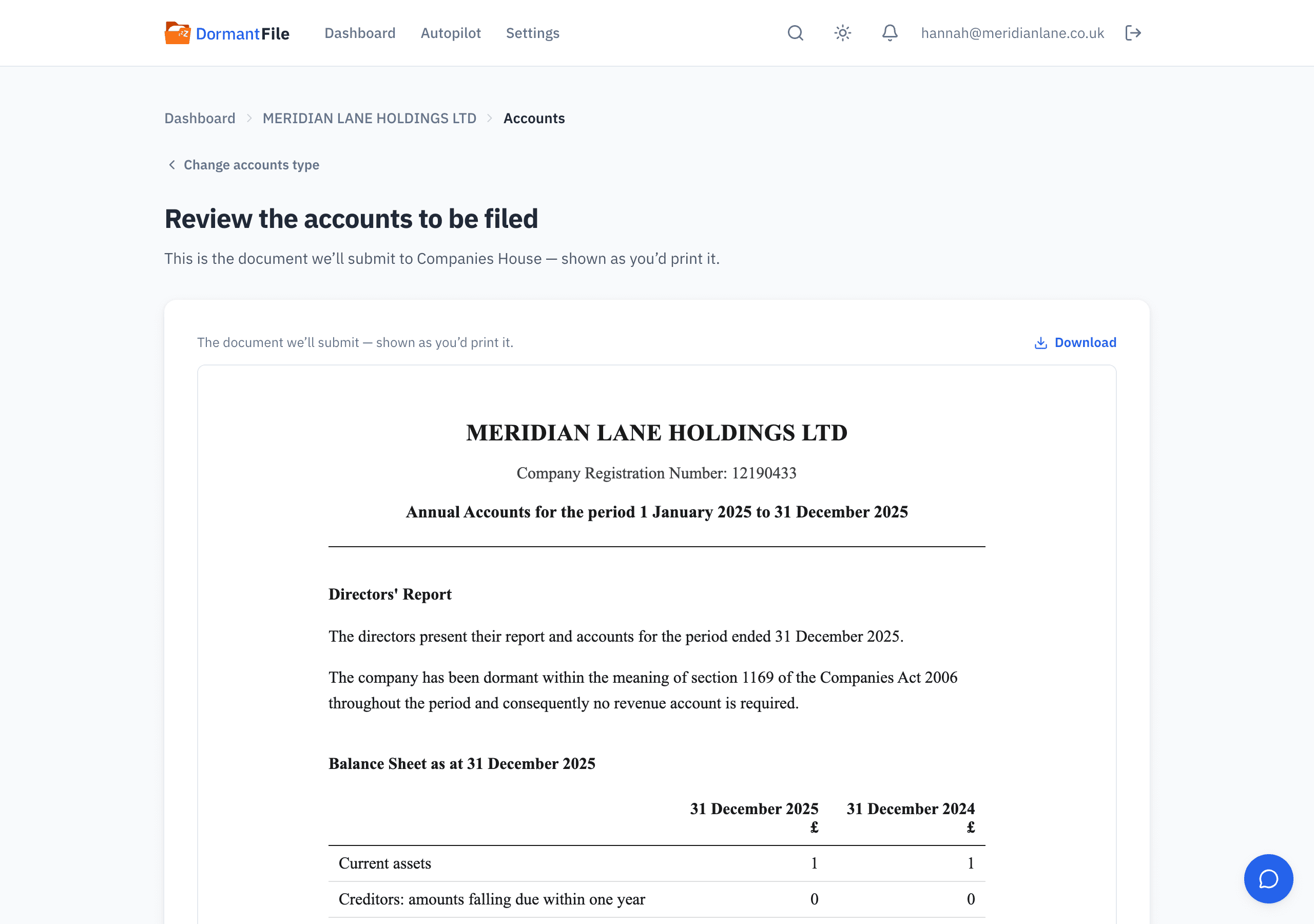
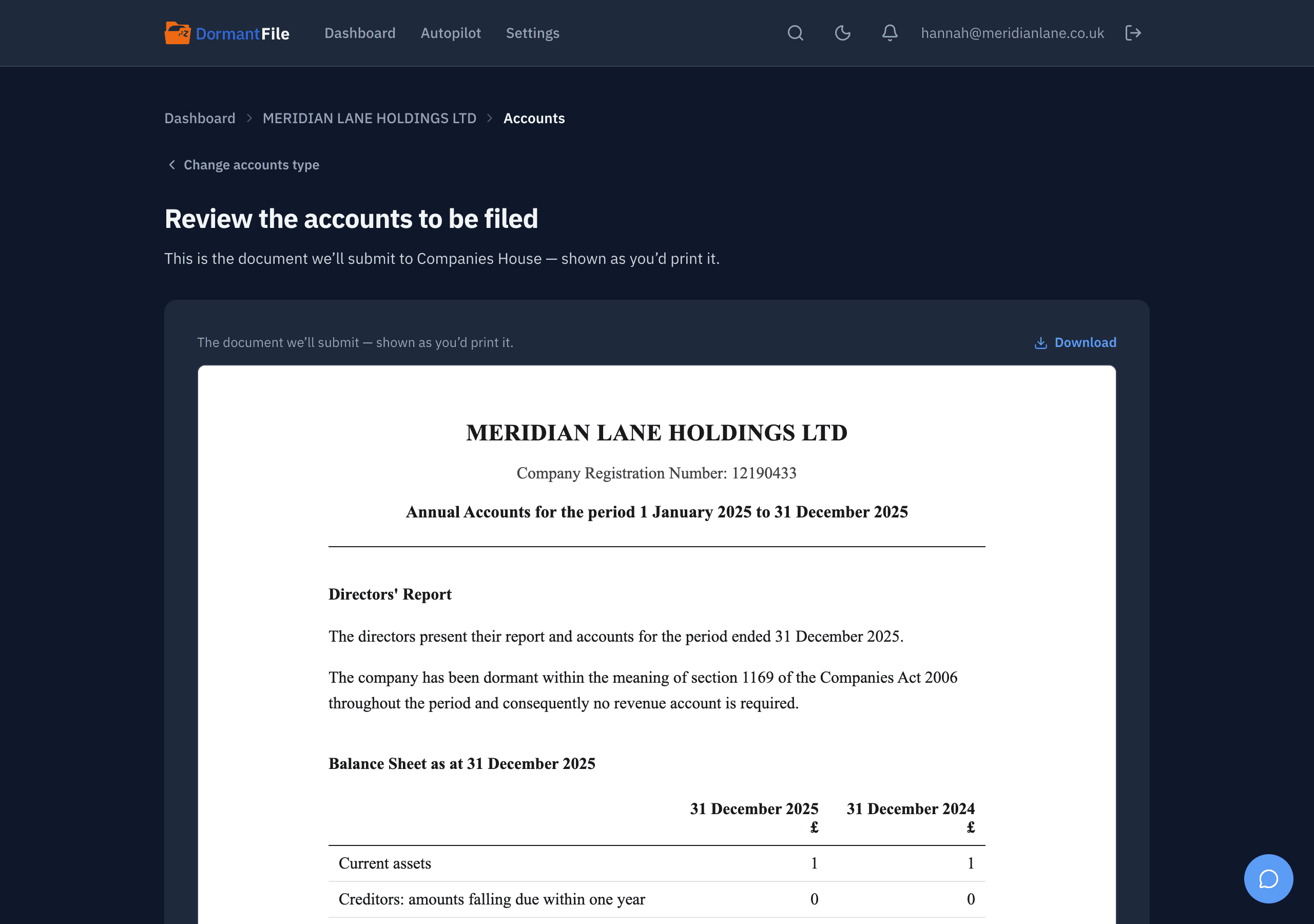
The balance sheet
A dormant company has had no significant accounting transactions in the year — nothing went in or out of its books — so its balance sheet normally shows what it already held when the year began. For most companies that is just the called-up share capital (what the shareholders paid, or agreed to pay, for their shares): £1 for a single £1 share, shown once as an amount owed by the shareholder (or held as cash) and once as capital. The prior year appears as a comparative column and, because nothing has moved, the two columns normally match.
Dormant doesn’t mean empty, though. A company that traded in the past and then stopped can still be dormant, and its balance sheet carries what it still holds from those years: cash, money owed to it, money it owes to creditors, bills owed but not yet paid (accruals), and fixed assets that don’t lose value each year, such as land, or shares in a subsidiary that haven’t lost value. It stays dormant only while nothing about those figures changes in the year — nothing paid or collected, no interest added, nothing written off or written down — so they normally match last year’s. DormantFile files these accounts too. You enter the figures, or start from the ones in the company’s last accounts on the public register, and check them before you continue. When DormantFile filed last year’s accounts, they carry forward on their own.
The director’s statements
Under the figures sit three statements the Companies Act requires:
- that the company was dormant throughout the financial year (section 480);
- that the members have not required the company to obtain an audit (section 476);
- that the directors acknowledge their responsibilities for keeping accounting records and preparing accounts that comply with the Act.
DormantFile writes these from the company’s own record: its legal form (limited by shares or by guarantee), its year end, and whether this is a first set of accounts.
Approval
The accounts are approved by the board and signed by a named director, with the date of approval. For an LLP a designated member (one of the members responsible for the LLP’s filings) signs instead. You confirm the name at the point of filing; it is printed on the document, not stored as a signature image.
What comes back
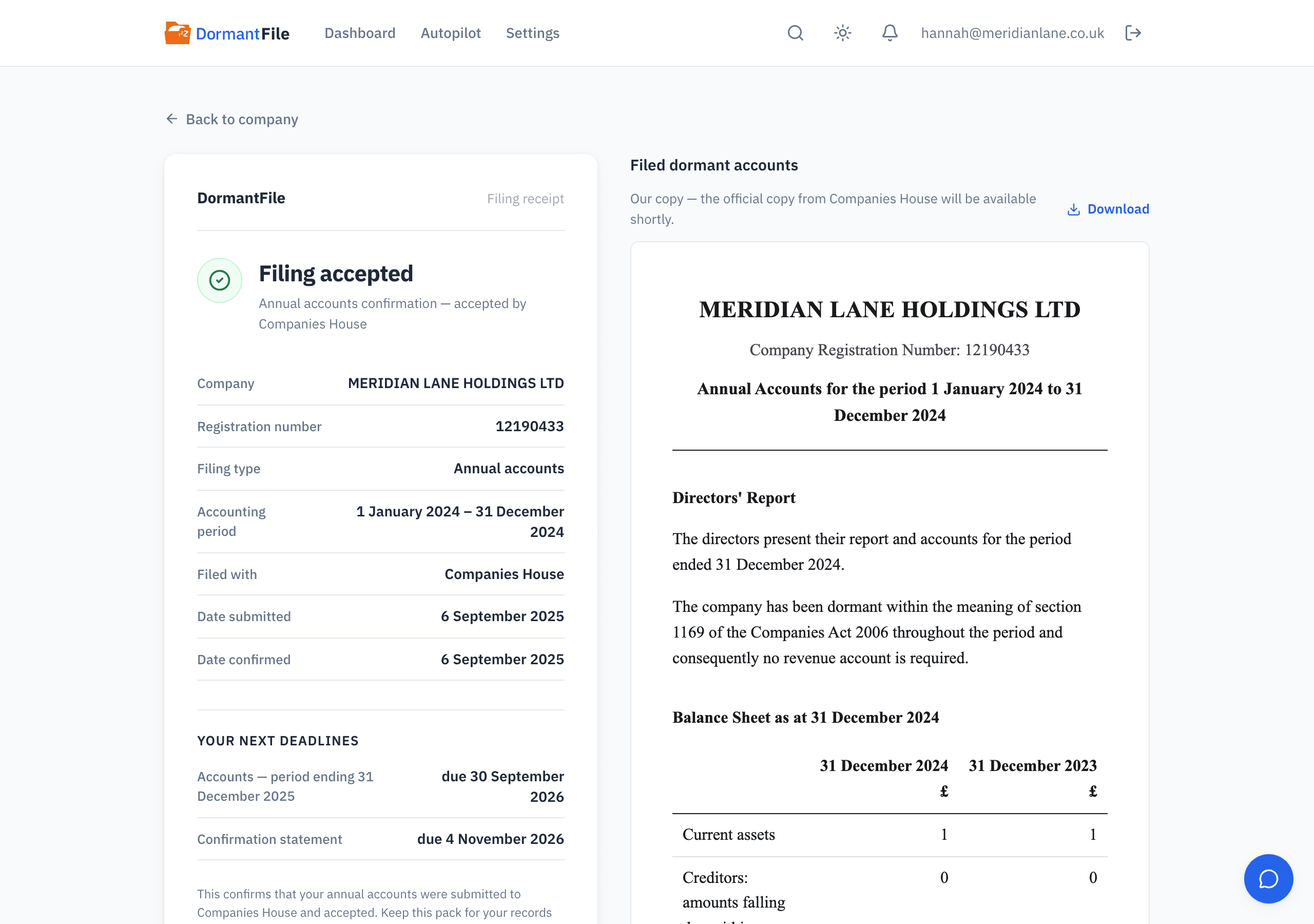
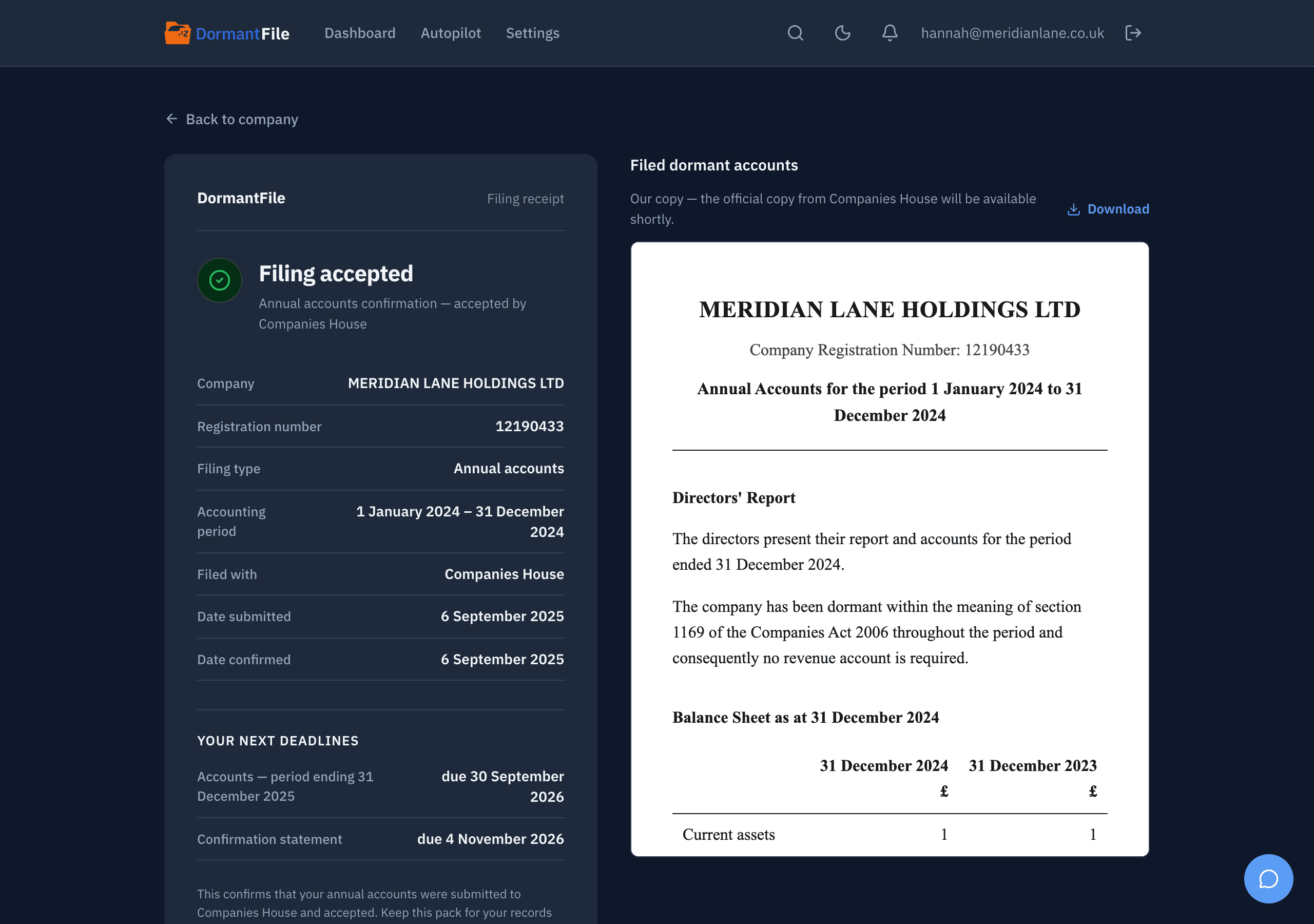
Companies House answers with a submission reference, and the filing shows as accepted in your account with a receipt you can download. The accounts appear on the public register shortly after.
Not quite dormant?
A company with a transaction or two during the year — a Bounce Back Loan being repaid, say — isn’t dormant and cannot use this document. It files FRS 105 micro-entity accounts instead, which DormantFile also prepares.
Common questions
- How long are dormant company accounts?
- One page of substance. A dormant company's accounts are a balance sheet with the required statements underneath it and the director's approval. There is no profit and loss account and no directors' report.
- What figure goes on a dormant company's balance sheet?
- Usually just the called-up share capital (what the shareholders paid, or agreed to pay, for their shares) — £1 for a company with a single £1 share — shown as both an asset (owed by the shareholder or held as cash) and as capital. But dormant doesn't mean empty. A company that traded before can still be dormant, as long as nothing about its figures changes in the year — nothing paid or collected, no interest added, nothing written off or written down. Its accounts then show what it still holds — cash, money owed to it, money it owes to creditors, bills owed but not yet paid (accruals) — the same at both year ends.
- Does a dormant company need an audit?
- No. The accounts carry a statement that the company was entitled to exemption from audit under section 480 of the Companies Act 2006 and that the members have not required one.
- Is the example above what Companies House receives?
- Yes. DormantFile shows you exactly the document it is about to send, and Companies House receives that document in the digital format it requires (iXBRL), sent through its filing route for software. The receipt shows the filing reference Companies House issued.